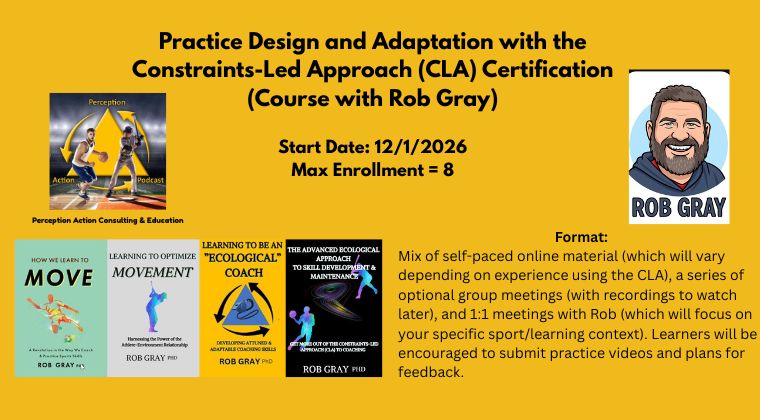
Practice Design and Adaptation with the Constraints-Led Approach (CLA) Certification
***NOTE: Both the Winter (starting 12/1/26) and Spring sessions (starting 4/1/27) are now Full! I will be opening other sections in a couple of months – if you would like to be added to the waitlist, please contact me.
Instructor: Rob Gray
The Constraints-Led Approach (CLA) is becoming one of the most popular and successful coaching methods.
NY Times Article: https://www.nytimes.com/athletic/6665943/2025/09/29/sports-training-cla-coaching-wembanyana-ohtani/
David Epstein’s new book: https://www.amazon.com/Inside-Box-Constraints-Make-Better/dp/0593715713
This certification course will help coaches and instructors develop their skill in using the CLA including: (i) the initial practice design, (ii) using performance analytics to support design, (iii) scaling constraints to optimize challenge, (iv) adapting the constraint based on performance, (v) guiding self-organization via instructions, feedback and questioning, (vi) progressing constraints and (vii) tracking and measuring progress. The course will cover the theoretical foundations of the CLA and the basic principles. During 1:1 meetings (and associated practical assignments) you will also learn how to apply the CLA in your specific sport/instructional context.
This course is designed for (and will adapt to) individuals wanting to start using the CLA and those who have already experienced some success and want to take it to the next level.
Course content will be a mix of self-paced online material (which will vary depending on experience using the CLA), a series of optional group webinars (with recordings to watch later), and 1:1 meetings (which will focus on your specific sport/learning context). Learners will be encouraged to submit practice videos and plans for feedback.
No coach is considered certified until they have completed the final quiz of the course.
Upon completion of the course, coaches will be considered certified.
Maximum enrollment = 8
Duration = 4 months (roughly)
Cost: $1,995 USD
($399 now to secure your place, then $399/month after the course starts)
———————————————————————————————————————————-
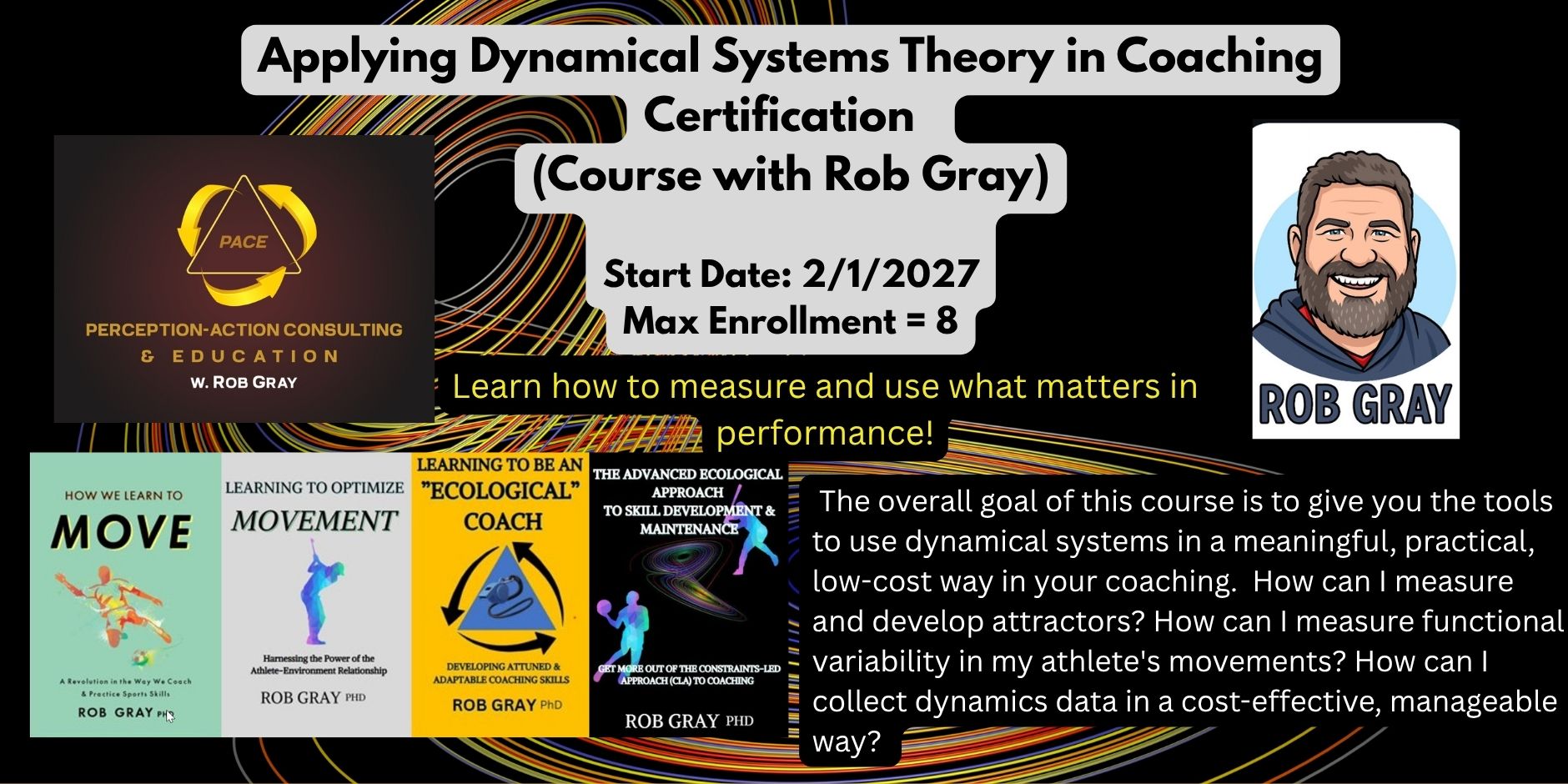
Applying Dynamical Systems Theory in Coaching Certification
-Go beyond just the big words and learn how you can apply DST concepts in practice. How can I measure and develop attractors? How can I measure functional variability in my athlete’s movements? How can I measure complexity? Critical fluctuations? How can I collect dynamic data in a cost-effective, manageable way?
**Taking enrollment for the first session (starting Feb 1, 2027) now. Please DM or email me know if you would like to secure your spot.
Course description:
Learn how to measure and use what matters in performance!
The overall goal of this course is to give you the tools to use dynamical systems in a meaningful, low effort, low-cost way in your coaching. We will explore a few different ways to do this: (i) developing observational techniques and diagnostic constraints to evaluate key attractors/invariants in your athletes, (ii) knowing what to look for when deciding if a practice activity is “working” or needs to be changed (variability, stability, exploration), (iii) collecting and analyzing data using body mounted IMU sensors, (iii) analyzing performance using camera-based data. Examples of the latter two will be evaluating interpersonal synchrony in martial arts and kinematic sequencing in sporting actions like hitting, throwing and catching. Further cases will depend on each person’s individual sport, topic area.
The course will run for a total of 16 weeks. It is purposely designed to be “prepared not planned” (i.e., with some flexibility in the specific content that can be adapted to each person’s needs).
All assignments, 1:1 meetings with Rob, and Group activities must be completed in that time frame. After this period, students will have an additional 4 weeks to complete all online, self-paced materials and quizzes (including the final quiz). Following completion of the course, students will have permanent access to the materials and will be invited back to “Alumni” meetings during future sessions of this course.
**Coding experience is not required for this course. Students will be given code to run, and we will see how it can be modified for your specific purpose using AI vibe coding.
Topics to be Covered:
All of this material will be covered via pre-recorded video lectures with associated quizzes.
- Collecting and Working with Time Series Data. (cleaning, filtering, parallax error, min requirements)
- Coordination Dynamics: The Basics
- What is complexity and how does it relate to sports Injury?
- Attractors and Invariants
- Nonlinear measures: Entropy, the Lyapunov Exponent, the Hurst exponent
- Nonlinear measures of good and bad variability (e.,g, Uncontrolled Manifold)
- Measures of interpersonal coordination, Relative Phase
- Tracking progress and measuring improvement
More details coming soon…
Group Meetings:
There will be 4 group meetings (roughly once per month). The purpose of these meetings will be to get together as a group to ask questions, share experiences, and do some peer assessment. For each meeting, 2 students will be asked to bring an example of some data they collected (video, time series, observational) which will be discussed as a group. My hope is that everyone will be collecting some of their own data but if necessary I will provide data to work with
We will do our best to find times and days that work for everyone, but attendance at these meetings is optional, except that all students must attend at least one meeting to share their work with us. All meetings will be recorded. Students who cannot attend live will be asked to write short written feedback for the materials presented in the meeting.
1:1Meetings with Rob:
During the course, students will be expected to have three 1:1 Zoom meetings with Rob, scheduled at times that work for both of us. The purpose of these meetings will be to get more specific to the sports or instructional domain each person is working in. After the first Introductory meeting, Rob will assign short “assignments” (readings, practice tasks to perform, etc) that students are expected to complete before the next meeting. The specifics of these will depend on the topic. As part of these meetings, I will also help you identify tech solutions that might work for collecting data in your sport.
Assignments:
These will be assigned at different points in the course based on each person’s interests and the issues that come up during discussion. I am hoping this will be co-adaptive too, with students getting involved in the process of their assessment. I want to keep this adaptable and flexible instead of using the same basic set of assignments for everyone.
Examples could include:
-measuring variables like entropy in a sample data set
-analyzing a particular athlete’s movement solution through the lens of attractors and invariants
-collecting some data of your own
Completion of the Course:
All students must complete an online quiz that tests comprehension of key DST concepts with a score >80%. After course completion, students will be “Certified by PACE-Rob Gray” and will receive a digital certificate.
Maximum enrollment = 8
Duration = 4 months (roughly)
Cost: $1,995 USD
($399 now to secure your place, then $399/month after the course starts)